


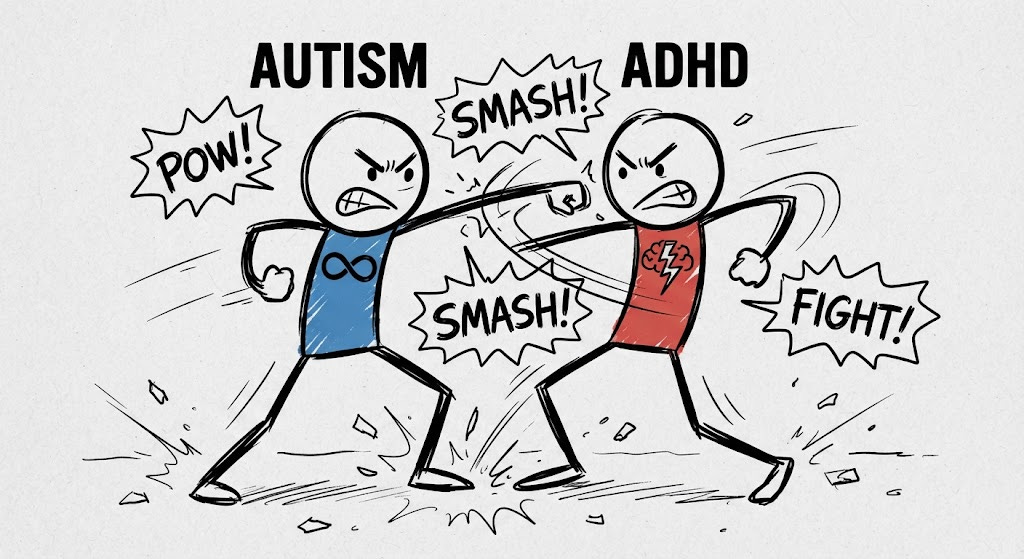
I wasted 2 hours of my life fighting a campy psychopathic dictator with the worst character in the game. If you want to know why, read on.
What is AuDHD?
I’ll be honest with you; AuDHD is not on the DSM-5. It’s not a recognised condition. Not really anyway, at least not clinically. There is genuine debate amongst clinicians about whether to treat ADHD and Autism as separate distinct conditions, or to treat Neurodivergence as a single entity with multiple facets. Both arguments are valid and the debate is far from closed.
I’ll get to the dictator shortly.
As I sat down to write this, I considered likening AuDHD as having the twin gods of Phobos and Deimos in your head. However, I rejected this idea. I considered Apollo and Dionysus too, but these didn’t seem to capture the nuance adequately.
Hephaestus and Hermes
I actually think Hephaestus and Hermes are the best pair. Hephaestus is the ultimate hyper-fixated autistic craftsman. He retreats to his forge, ignores social conventions and systemises his environment to create masterpieces of engineering. Hermes is the ADHD mind; he is the god of speed, crossing boundaries, carrying a hundred messages at once. He’s easily distractible but capable of lateral leaps of logic that nobody can equal. One is the master of deep, immovable focus; the other is the master of restless velocity.
How Autism and ADHD Interact
The truth is, a person with ADHD and Autism is often in a state of internal conflict. Needing novelty, interest and spontaneity, whilst also needing structure, routine and completeness.
The Autistic Mind
You might find an Autistic person takes an interest in a hobby. Let’s say chess. They may find themselves drawn to chess because it’s a perfect, closed information system. There are no hidden cards or dice rolls; you don’t have to learn 14 different factions’ army rules or spend thousands of pounds constructing decks from out-of-print cards to play competitively. Logic is absolute. It may appeal to autistic individuals as well because it values systemisation over socialisation. A competitive chess match removes the exhausting social friction of neurotypical social interaction. You aren’t expected to engage in small talk, interpret micro-expressions, or decipher tonal ambiguity. Communication is logical and mathematical. The most you are expected to say is ‘Good luck’ at the start, then at the end, either ‘checkmate’ or ‘well-played, good game’.
It’s a game of pattern recognition and autism loves patterns.
The ADHD Mind
It’s highly plausible that the ADHD mind will be equally drawn to chess. Particularly the dopamine rush of frantic 1-minute, online bullet chess games. But the ADHD Mind is less likely to succeed at chess, because to that ADHD mind the monotropic study of chess positions, tactics, openings, strategy, pawn structure etc… Is just too much of a grind. It’s interesting, but serious chess is mostly patient study, not dopamine farming. An ADHD’er who gets into chess will probably simultaneously get into 14 other things and flit between them, occasionally dropping and picking up other hobbies along the way.
The AuDHD Mind
The AuDHD Mind is drawn to the interest and diversity of the ADHD mind, but instead of being content to simply flit from interest to interest, every interest instead piles up, each one having to be studied in depth until the individual’s brain is absolutely fried and the cognitive load is causing the individual significant distress.
What it’s like when Worlds Collide
I’ll give you an example of when these conflicting states can be catastrophic. For context, I should explain the game in question to you. The game is Super Street Fighter II Turbo. The name is almost as long as the chequered and contentious history of the game. There had already been 5 iterations of Street Fighter before this title hit the Arcades. If you play it on the 30th Anniversary Xbox Collection, you get a version which is emulating the Arcade machine accurately. So accurately it even emulates the broken difficulty setting unique to the English version of Super Street Fighter II Turbo Arcade. Whatever you set the difficulty to, the computer always plays on absolute maximum difficulty. This was an error on the original circuit board and it was emulated with precision. To make matters worse the computer does not play like a person. Instead of watching the character on screen, it reads your inputs and reacts on a perfect frame timing to counter anything you throw at it. It also does not need to perform complex inputs to pull off special moves, and it doesn’t need to charge for ‘charge special moves’. So if a player had to hold ‘back’ and count to three before pressing forward and punch for a fireball, the computer can just be walking forwards and throw two of those fireballs out in quick succession. This makes for a brutal, quarter-devouring, arcade experience. You can beat it, but the way to beat it is counter-intuitive and relies on ensuring your moves are out of sync with your inputs, for example by completing special move inputs while landing or blocking so the animation is delayed.
I’d had a nice night. I’d been teaching my wife to play Cyberpunk 2077. She finished and I played a few rounds of Super Street Fighter II Turbo with my daughter. I’d been on Arcade mode and we played so many rounds the only CPU fight left was the boss fight M. Bison. I asked my daughter which ending she’d like to see thinking I’d just beat the boss. She chose the combatant from England, Cammy. Now Cammy is a particularly weak character in Super Street Fighter II Turbo. It is possible to win with her, but it requires exacting precision and consistent perfect play. I am not a Cammy player. I spent two hours. Two damned hours I will never get back trying to beat M. Bison with Cammy. There was literally no reason to. I could have turned it off and shown her the ending on YouTube. However, my ADHD brain found the challenge interesting, and it anticipated a dopamine hit. However, there comes a threshold point where after so many tries my Autistic brain becomes locked on. I’d expected completion of the task and that expectation not being met felt absolutely existential. In the end I gave up and went back to a character I’m good with - Vega (Or Claw if you’re playing the Japanese version). I spent another hour calibrating how to get attacks to land by obfuscating the animation start times from the inputs and finally managed to beat M. Bison and complete the game. The minute it was done? No dopamine hit. No huge sense of achievement, just a weary, embittered sense of relief and anger at having wasted a night. The truth? Once I was in that state, stopping was not an option.
The same happened playing Kingdom Come: Deliverance II a few months ago. I was waylaid by a couple of vagabonds while travelling to a new town. I spent two hours re-playing the same 2-minute encounter over and over, determined to beat it. There was no reason to. I should have run off, levelled up, bought better gear and come back. However, once I’d decided I was going to beat it, I had to beat it, no matter how absolutely irrational that intention was.
There may be times when this ADHD hyperfocus and Autism driven tenacity can produce world-changing benefits, but in my experience when these traits collide in the worst way, it’s an unbreakable curse that leaves me feeling weary, exhausted and hollow, from the battle going on in my head.
The combination of traits can be extremely powerful, but you have to be very careful where you aim it. The very next day, I decided to take the 1,700-word vocabulary list for the 2026 AQA GCSE German examination and build a quiz app for learning the words, along with the ‘der, die or das’ for my son. Within two hours I’d made it, and it works!
If you’re taking the AQA German GCSE this year and want to learn the vocabulary, you can try my app here.
Martyn
